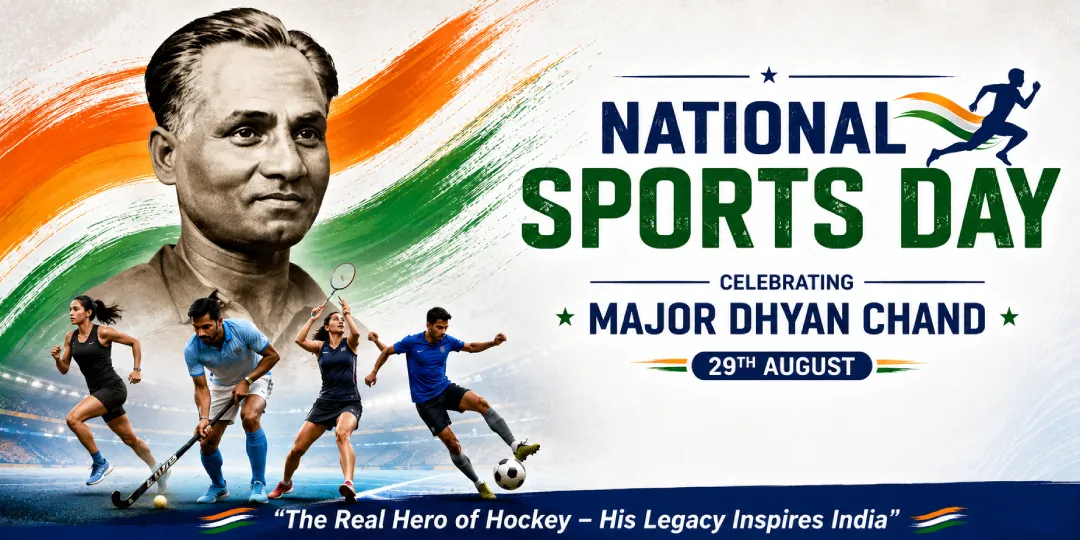
India marks National Sports Day on 29 August, the birthday of hockey player Major Dhyan Chand. This year it fell in the same month the government announced the National Sports Awards 2025 without a Major Dhyan Chand Khel Ratna, India’s highest sporting honour. It is only the second time the award has gone unawarded, after 2014.
National Sports Awards 2025: no Khel Ratna
The selection committee, headed by retired Supreme Court judge Justice Arun Kumar Mishra, did not recommend anyone for the Khel Ratna. The award recognises the most outstanding performance by a sportsperson over the previous four years, and the panel did not find a candidate who met that standard.
The decision drew attention because the Khel Ratna has been given every year since 2015, often to several athletes at once. In 2021, the year of the Tokyo Olympics, 12 sportspeople received it.
The awards that were given
| Award | Recipients |
|---|---|
| Major Dhyan Chand Khel Ratna | Not awarded |
| Arjuna Award | 17 athletes |
| Dronacharya Award (coaches) | 6 coaches |
| Lifetime achievement | I. Arumainayagam |
| Rashtriya Khel Protsahan Puruskar | Army Paralympic Node, Pune |
The Arjuna Award winners include race walker Priyanka Goswami, high jumper Tejaswin Shankar, 400m runner Muhammed Ajmal, badminton’s women’s doubles pair Treesa Jolly and Gayatri Gopichand, and hockey players Lalremsiami and Rajkumar Pal.
Treesa and Gayatri also won a women’s doubles bronze at the BWF World Championships in New Delhi, India’s only medal of the event. Our BWF World Championships 2026 results page has the full story.
Who was Dhyan Chand?
Dhyan Chand was born on 29 August 1905 in Allahabad, now Prayagraj. He joined the British Indian Army as a teenager and learned his hockey in regimental games. He went on to become the defining player of the era when India dominated Olympic hockey, and he later rose to the rank of Major, the title by which he is still known.
His control of the ball was so close that opponents and officials sometimes asked to examine his stick. He finished his career with a reputation, not a statistics sheet: international records from the 1920s and 1930s are incomplete, and the goal totals quoted for him vary widely between sources, so we do not repeat them here.
Three Olympic gold medals
| Olympics | Host city | Result |
|---|---|---|
| 1928 | Amsterdam | Gold, India’s first Olympic hockey title |
| 1932 | Los Angeles | Gold, including a 24-1 win over the United States |
| 1936 | Berlin | Gold, with Dhyan Chand as captain; India beat Germany 8-1 in the final |
India went on to win the Olympic hockey gold in 1948, 1952 and 1956 as well, completing six titles in a row. Dhyan Chand’s younger brother, Roop Singh, played alongside him in 1932 and 1936.
Honours and legacy
- 1956: awarded the Padma Bhushan, India’s third-highest civilian honour.
- 1979: died on 3 December in Delhi.
- 2002: the National Stadium in New Delhi was renamed the Major Dhyan Chand National Stadium.
- 2012: his birthday was first observed as National Sports Day.
- 2021: the Rajiv Gandhi Khel Ratna was renamed the Major Dhyan Chand Khel Ratna, months after India’s men’s hockey team won Olympic bronze in Tokyo.
How National Sports Day is marked
The day is traditionally when the President presents the National Sports Awards at Rashtrapati Bhavan, although the ceremony has not always been held on 29 August itself. Schools, colleges and sports bodies hold events, and the Fit India Movement, a government fitness campaign, was launched on National Sports Day in 2019.
The National Sports Awards explained
| Award | What it recognises |
|---|---|
| Major Dhyan Chand Khel Ratna | The most outstanding performance by a sportsperson over the previous four years |
| Arjuna Award | Consistently good performance over four years, plus leadership and sportsmanship |
| Dronacharya Award | Coaches who have produced medal-winning athletes at major international events |
| Lifetime achievement | Long contributions to sport, as a player or after retirement |
| Rashtriya Khel Protsahan Puruskar | Organisations and companies that develop and promote sport |
| Maulana Abul Kalam Azad Trophy | The best-performing university in inter-university sport |
Selection is made by a committee of former athletes, coaches, journalists and administrators, appointed by the Ministry of Youth Affairs and Sports. Nominations are open to athletes and are also made by national federations.
Why a year without a Khel Ratna matters
The previous blank year, 2014, followed a period in which the award was given to one or two athletes. In the years since, the honour has been shared more widely, which has led to criticism that its value has been diluted. Supporters of the 2025 decision say holding it back restores the idea that the Khel Ratna marks a truly exceptional achievement, though it is hard on athletes who had strong four-year records without a headline Olympic or world title.
The next test comes with the 2026 awards cycle, which covers a year that included the Asian Games in Aichi-Nagoya, where India won 85 medals and 21 golds. See our India at Asian Games 2026 page for every Indian gold medallist.
Updated 7 October 2026. Sources: news reports of the Ministry of Youth Affairs and Sports announcement of the National Sports Awards 2025 (August 2026), and Olympic historical results.